






There’s something about starting a clothing brand from your bedroom that either breaks you or builds you. For Christian Rivas, it built an entire empire.
Ten years ago, Rivas launched Cartel from a small town with no money, no industry connections, and no safety net. What he did have was the weight of his parents’ immigration story on his shoulders and a refusal to let their sacrifices mean nothing. Today, the Mexican-American designer runs a seven-figure operation with close to 100 retailers carrying his line, according to Rivas, plus a custom print shop servicing clients like BMW and Mercedes, and a warehouse he built on his own property.
The trajectory sounds clean when you put it that way, but the reality was anything but. Rivas spent years driving cars without air conditioning, years not paying himself, years in the red and flirting with bankruptcy. He faced breakups because of relentless work hours. He poured every dollar back into the business when most people would’ve called it quits. The fashion industry doesn’t care about your story or your work ethic, it’s cutthroat and built on creative expression that’s nearly impossible to monetize consistently. Rivas did it anyway.

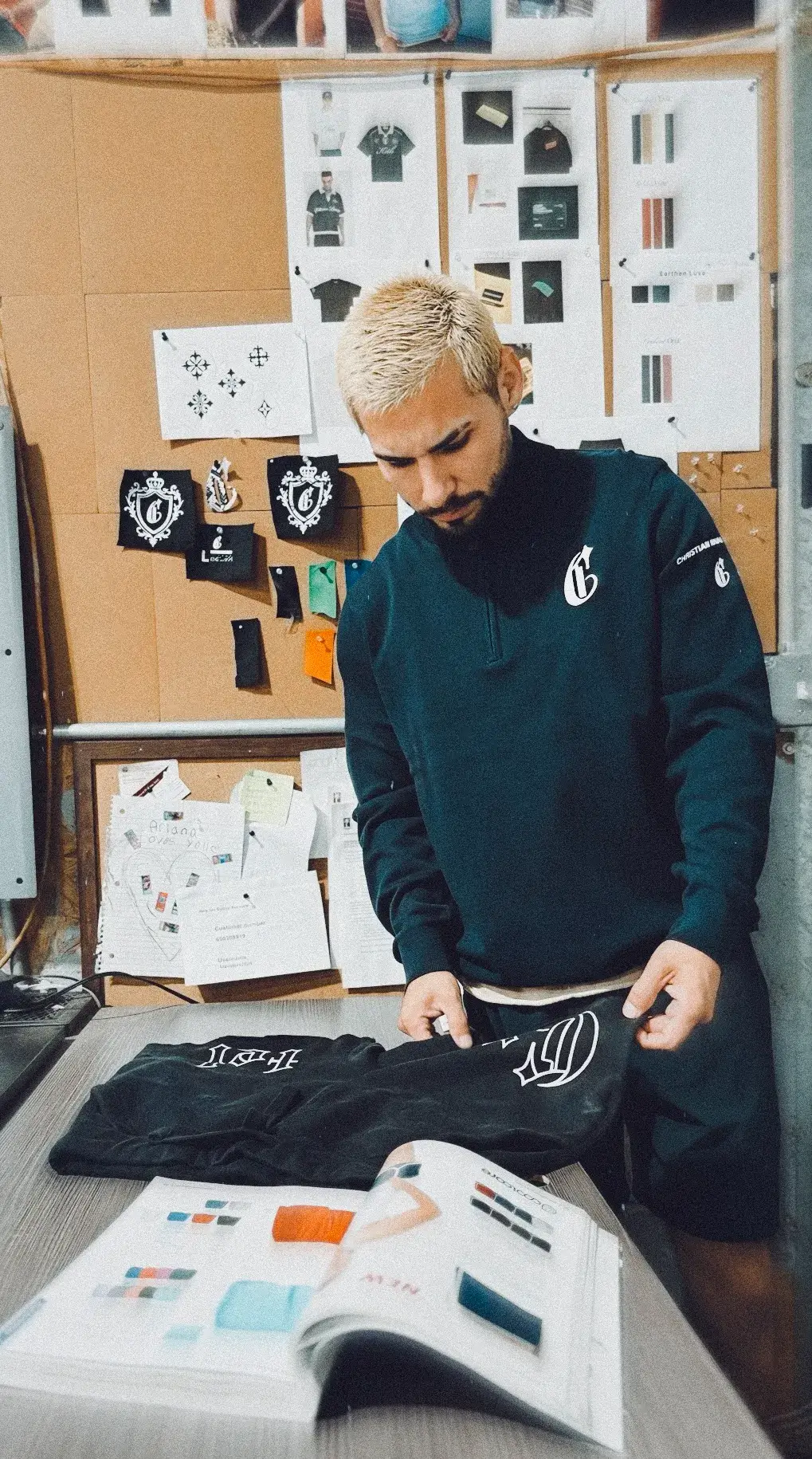
What makes Cartel different from the thousands of failed streetwear brands that launch and fold every year isn’t just persistence. It’s the production infrastructure. Rivas didn’t just design clothes and outsource everything, he built the entire operation himself. His Instagram presence tells the story better than any press release could. The main brand account shows polished product shots and clean drops with a dark, gothic aesthetic. The embroidery account shows the unglamorous reality: worktables, custom hat runs, piles of garments, proof that the work actually happens. His personal page mixes cars, gym content, and behind-the-scenes moments that don’t always paint the perfect picture.
That combination of front-end polish and back-end transparency is rare. Most brands either hide the messy parts or oversell the hustle without showing the actual product. Rivas runs it all in real time, and you can see the cost of it. There are glimpses into early financial stress. A post about the tragic loss of his nephew, where he asked for support for his brother’s family while acknowledging he usually keeps personal life separate from business. The kinds of moments most brands wouldn’t share, but they make him feel like an actual person instead of a faceless logo.
The aesthetic he’s built around is specific and consistent. Heavy graphics, skull and chainmail motifs, that stark gothic “C” mark showing up everywhere. It’s not trying to be streetwear for everyone, it’s curated and tight, the kind of thing that finds its audience and holds onto them. The product shots are clean, the branding is cohesive, and there’s enough variety between minimal logo pieces and heavier graphic work to keep things interesting.
But the real flex is the print shop. Rivas constructed a full-service facility on his property, right next to his house. That’s not just a side hustle, that’s a vertical integration play most small brands can’t pull off. When you’re printing for major automotive companies, you’re not running a hobby operation anymore. You’re a legitimate manufacturer with overhead, deadlines, and clients who expect professional results. The fact that he’s doing that while still running the clothing brand shows the kind of work capacity that separates builders from talkers.
Rivas frames a lot of his success through faith. He talks about putting it all in God’s hands, walking by faith instead of sight, believing that what’s meant for you will come to fruition. There’s a philosophy buried in there about having nothing to lose because you can’t take anything with you anyway. It’s the kind of mindset that gives you permission to risk everything without the fear that stops most people from even starting.
He’s open about the fact that your darkest times reveal who you really are, and that you can’t measure character only when things are comfortable. That a true person is made through suffering, not success. It’s heavy, but it tracks with the origin story. When you start with nothing and build to seven figures through sheer force of will, you develop a different relationship with risk and sacrifice.
What’s clear from watching Rivas’s journey is that he had the work ethic, the vision, the willingness to suffer through the lean years, and the skill to execute at a high level across design, production, and business operations. That combination, paired with the refusal to quit when things get hard and the decision to build infrastructure instead of just chasing quick wins, is what separates a decade-long business from a failed experiment.
Right now, Rivas is living in the house he dreamed about, raising a family, and running multiple businesses from his property. The bedroom where it all started is probably a distant memory, but the hunger that got him out of it clearly hasn’t gone anywhere. He’s proof that you can build a legitimate manufacturing operation without connections or capital if you’re willing to put in a decade of work that most people quit after year two. For anyone interested in following his work, check out Cartel, his personal page, or Rivas Embroidery.